Backgammon Rules & How to Play
The standard game: hit blots, make points, and bear off. A gammon scores double and a backgammon scores triple. It is included in Backgammon 18 Games, the free Android and iOS app by Geimz ltd.
At a glance
- Hitting
- Yes. A lone checker is hit and sent to the bar.
- Direction
- Players move in opposite directions.
- Doubling cube
- Yes
- How you win
- Bear off first. A gammon scores double, a backgammon triple.
Rules
Board setup
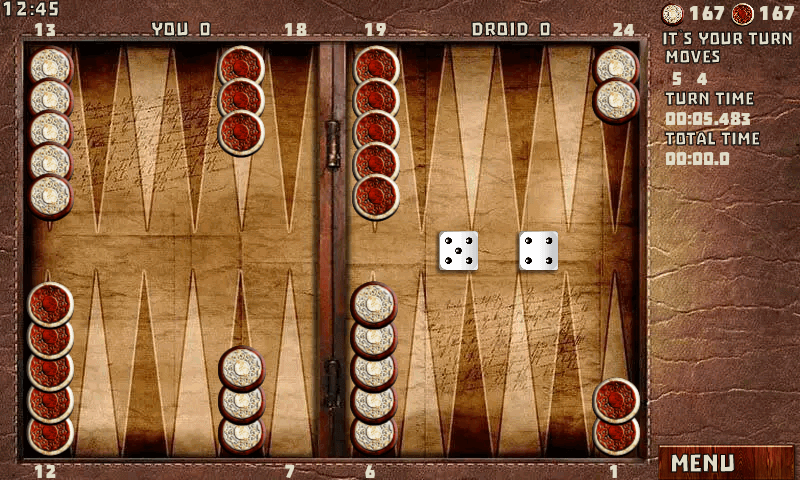
Each player has 15 checkers: two on the 24-point, five on the 13-point, three on the 8-point and five on the 6-point. Number the points from your own side; your home board is points 1–6. The players move in opposite directions.
Objective and opening roll
The object of the game is to move all your checkers into your own home board and then bear them off. The first player to bear off all of their checkers wins the game.
To start the game, each player throws a single die. This determines both the player to go first and the numbers to be played. If equal numbers come up, then both players roll again until they roll different numbers. The player throwing the higher number now moves his checkers according to the numbers showing on both dice. After the first roll, the players throw two dice and alternate turns.
Moving checkers and playing doubles
The roll of the dice indicates how many points, or pips, the player is to move his checkers. The checkers are always moved forward, to a lower-numbered point. The following rules apply:
1.A checker may be moved only to an open point, one that is not occupied by two or more opposing checkers.
2.The numbers on the two dice constitute separate moves. For example, if a player rolls 5 and 3, he may move one checker five spaces to an open point and another checker three spaces to an open point, or he may move the one checker a total of eight spaces to an open point, but only if the intermediate point (either three or five spaces from the starting point) is also open.
3.A player who rolls doubles plays the numbers shown on the dice twice. A roll of 6 and 6 means that the player has four sixes to use, and he may move any combination of checkers he feels appropriate to complete this requirement.
4.A player must use both numbers of a roll if this is legally possible (or all four numbers of a double). When only one number can be played, the player must play that number. Or if either number can be played but not both, the player must play the larger one. When neither number can be used, the player loses his turn. In the case of doubles, when all four numbers cannot be played, the player must play as many numbers as he can.
Hitting and entering from the bar
A single opposing checker can be hit and sent to the bar. Before moving any other checker, bring every checker on the bar back into play in the opponent’s home board. Use a die to enter on the corresponding point; two or more opposing checkers block entry. If neither die permits entry, your turn ends.
Bearing off
Once a player has moved all of his fifteen checkers into his home board, he may commence bearing off. A player bears off a checker by rolling a number that corresponds to the point on which the checker resides, and then removing that checker from the board. Thus, rolling a 6 permits the player to remove a checker from the six point.
If there is no checker on the point indicated by the roll, the player must make a legal move using a checker on a higher-numbered point. If there are no checkers on higher-numbered points, the player is permitted (and required) to remove a checker from the highest point on which one of his checkers resides. A player is under no obligation to bear off if he can make an otherwise legal move.
Scoring: single game, gammon and backgammon
At the end of the game, if the losing player has borne off at least one checker, he loses only the value showing on the doubling cube (one point, if there have been no doubles). However, if the loser has not borne off any of his checkers, he is gammoned and loses twice the value of the doubling cube. Or, worse, if the loser has not borne off any of his checkers and still has a checker on the bar or in the winner's home board, he is backgammoned and loses three times the value of the doubling cube.
Learn with examples
These practice positions explain legal moves, not the best strategy. Each example is a separate position; special opening and scoring rules are described above.
Starting layout
For these examples, number the points along your own route from 24 down to 1. Your home is 6–1. The opponent has their own numbering; screen orientation can differ. The table describes the app variant.
| Point or location | Checkers |
|---|---|
| 24 | 2 |
| 13 | 5 |
| 8 | 3 |
| 6 | 5 |
Players move in opposite directions.
A move with 3 and 2
Consider a middle-game position: all checkers have entered, opening restrictions are satisfied, and you have no pinned checkers or checkers on the bar. One of your checkers is on 10; points 7, 8 and 5 are empty.
With 3 and 2, move that checker 10 → 7 → 5. You can also play 10 → 8 → 5 by using the 2 first. Each arrow uses one die. If both intermediate points, 7 and 8, are blocked, this checker cannot reach 5 in that turn just because 3 + 2 = 5.
Meeting an opposing checker
Separate example: your checker is on 10 and an opposing checker stands alone on 7, outside your home. You have no checker on the bar and already have a checker in your home. A 3 lets you move 10 → 7 and send the opposing checker to the bar. Two opposing checkers on 7 would block that move.
Bearing off: an exact roll and a larger roll
You have already borne off all but two checkers. The remaining two are free in your home: one on 5 and one on 3. There are no checkers on the bar or waiting to enter. You roll 6 and 3.
Use the 3 to take the checker off point 3. Then use the 6 to take the checker off point 5: there is no checker on 6 or any higher point. Both checkers leave the board. Whether this wins the game depends on the variant; Backgammon to Lose reverses the objective.
Common mistakes to avoid
- Adding the dice together and ignoring the intermediate landing point. A move using both dice must be legal in at least one order.
- Bearing off a lower checker with a larger die while another checker remains higher. For example, a 5 cannot bear off from 4 while you still have a checker on 6.
- Treating a double as two moves. In this variant, 4–4 gives four moves of four, subject to legal moves.
Examples use the rules on this page and the app’s starting layouts. Background on standard movement: Backgammon Galore
Also called Classic backgammon. Choose it from the game list, then play offline, online, or with a friend.